Capricor Therapeutics (NASDAQ: $CAPR): Turned a Rare Disease Into an Insider ATM
Reports
•

How Capricor Turned a Rare Pediatric Disease into a Decade-Long ATM for Insiders — Fueled by Grants, Ghost Entities, and Regulatory Fog.
Exploiting Rare Disease for Insider Profit
Capricor Therapeutics presents itself publicly as a beacon of hope for patients suffering from Duchenne Muscular Dystrophy (DMD)—an ultra-rare, devastating illness that impacts fewer than 20,000 young boys across the United States. The emotional intensity surrounding this condition has allowed Capricor to secure tens of millions in taxpayer-funded grants and repeatedly tap retail investors, despite having no FDA-approved therapies after nearly two decades of operations.
Yet our exhaustive forensic investigation reveals Capricor as little more than a sophisticated financial vehicle designed to systematically enrich insiders at the direct expense of patients, taxpayers, and retail investors. Beneath the compassionate veneer lies a troubling pattern of clinical stagnation, deliberate opacity, and chronic insider profiteering.
Key Findings:
Exploitation of DMD: Leveraging the narrative of a tragic, terminal, ultra-rare disease for taxpayer grants and investor fundraising, despite minimal commercial prospects and no meaningful clinical progress.
Hidden Insider Enrichment: A web of undisclosed entities connected to Chairman Frank Litvack, including WHE Investments, IHCF Investments, and SPOC Global Consulting, raising serious conflicts of interest.
Financial Mismanagement & Opacity: Repeated manipulation of trial milestones, aggressive dilution, questionable PPP loan use, and suspicious insider trading patterns.
Regulatory & Scientific Risk: Chronic delays in clinical trial progression, suspicious protocol amendments, and disturbing whistleblower claims of data manipulation and regulatory non-compliance.
Ultimately, Capricor appears not to be advancing groundbreaking medical therapies—but rather operating as a cynical biotech ATM, converting patient hope and taxpayer dollars into private insider profits.
Duchenne Muscular Dystrophy—A Disease Exploited
Duchenne Muscular Dystrophy (DMD) is an emotionally charged and tragically terminal illness, affecting roughly 1 in every 3,500 to 5,000 male births. In the U.S., fewer than 20,000 young patients suffer from this devastating disease, characterized by rapid muscle degeneration, loss of mobility, and early death. The stark severity of DMD leaves parents and families desperately searching for a viable therapy, a vulnerability that Capricor Therapeutics (NASDAQ: CAPR) has methodically exploited.

Figure: A 15-year-old boy presented with progressive proximal weakness of the lower limbs starting at 4 years of age followed by involvement of the upper limbs.
Despite positioning itself prominently as a transformative innovator in DMD therapy, Capricor has spent over 15 years operating in perpetual clinical limbo—trials consistently delayed, endpoints repeatedly shifted, and open-label extensions recycled indefinitely. Our investigation reveals an orchestrated cycle of announcing “promising” results that remain stubbornly stuck in preliminary phases, never progressing toward genuine FDA approval or market entry. Meanwhile, Capricor continues aggressively securing taxpayer-funded grants and retail investor capital, promising imminent breakthroughs that consistently fail to materialize.
Emotional Exploitation: Patient and Family Testimonials
The raw desperation for effective therapies among families dealing with DMD underscores the ethical severity of Capricor's ongoing fundraising strategies. Patient advocacy groups consistently express the agony of waiting for life-saving treatments:
“We don’t have the luxury of time… our children’s lives literally depend on these companies keeping their promises.”
— Parent Testimonial, Parent Project Muscular Dystrophy (PPMD), 2024
“Every day, we lose a little more hope. Companies tell us breakthroughs are coming, but years later, nothing reaches our kids.”
— Parent Testimonial, CureDuchenne Community Forum, November 2023
Repeated Promises, No Delivery: Press Release Patterns
Capricor’s public communications continually tout “promising” data and “transformational” outcomes, yet these claims consistently fade into obscurity. For example:
June 4, 2024 Press Release:
“Capricor Therapeutics Announces Transformational Data from HOPE-2 Open-Label Extension Demonstrating Long-term Cardiac and Skeletal Improvements in Duchenne Muscular Dystrophy Patients.”
Yet, despite this optimistic language, no corresponding FDA submissions or Phase 3 advancements have been publicly announced nearly two years later.
March 14, 2023 Press Release:
“CAP-1002 Shows Breakthrough Potential in Latest Interim Results; Pivotal Next Steps Expected.”
Again, two years passed without substantive progress toward pivotal studies or FDA filings, effectively recycling the same preliminary clinical data as "promising" breakthroughs without advancement.
Clinical Pharmacology: Absence Where It Matters Most
Despite Deramiocel (CAP-1002) being a biologic cell therapy under active FDA review, no publicly available pharmacokinetic (PK) or pharmacodynamic (PD) data exist to support its claimed mechanism of action or dose rationale.
There are no published studies quantifying:
Cell persistence or biodistribution
Dose–response correlation
Clearance rate or systemic exposure
Correlative cytokine, inflammatory, or fibrosis biomarkers post-infusion
This omission is not a technical oversight — it’s a strategic void. While cell therapies pose challenges for traditional PK measurement, regulators still expect substantiating evidence through cell tracking studies, quantitative PD biomarkers, or tissue-level mechanistic assays. In Deramiocel’s case, Capricor appears to have sidestepped that entirely.
Instead, the company leans on small, underpowered trials with function-based endpoints (PUL, LVEF), lacking biochemical substantiation. The HOPE-2 trial (n=20) is presented as statistically significant in investor decks, but the peer-reviewed MRI data published in The Lancet shows no statistically significant improvement in LVEF at 6 months (p=0.45).
The company shows us charts, not mechanisms. P-values, not persistence. “Slowing of disease,” not how or why.
This absence of pharmacology isn’t just a scientific failure — it’s a regulatory liability. If Capricor has not included PK/PD data in its BLA submission, the likelihood of receiving a Complete Response Letter (CRL) is high. The FDA has made clear through precedent that mechanism, dosing rationale, and tissue-target evidence are non-negotiable — especially for novel biologics.
Until Capricor provides verifiable, quantitative pharmacologic evidence, Deramiocel remains a mechanistic black box with a marketing gloss. The scientific burden of proof is unmet. The regulatory clock is ticking.
Chronic Clinical Delays & Endless Extensions: ClinicalTrials.gov Evidence
Public clinical trial data reveals a disturbing pattern of stagnation and indefinite delays. For example, Capricor’s prominent trials—HOPE-Duchenne (NCT02485938), HOPE-2 (NCT03406780), and subsequent open-label extensions (OLEs)—have remained mired in ongoing status for years:
|
|
|
|
| |||||
|---|---|---|---|---|---|---|---|---|---|
NCT02485938 | HOPE-Duchenne | June 2015 | June 2017 | Completed (no FDA submission) | |||||
1NCT03406780 | HOPE-2 | April 2018 | June 2020 | Completed (no FDA submission) | |||||
NCT04428476 | HOPE-2 Open-Label | July 2020 | June 2022 | Ongoing, no definitive end date |
These trial patterns strongly suggest a biotech strategy aimed at maintaining perpetual “ongoing” trials for continued funding rather than achieving true clinical milestones and moving toward commercialization.
Figure 3: Screenshot from ClinicalTrials.gov highlighting indefinite delays and prolonged trial statuses.
Description: Visual evidence of prolonged delays and indefinite extensions clearly illustrating Capricor's clinical stagnation.
Marketing vs. Reality: No Independent Validation
Capricor’s corporate language is consistently grandiose, touting “breakthrough” and “transformational” therapies without independent expert or regulatory affirmation. Notably absent from Capricor’s history are meaningful FDA endorsements such as Fast Track, Breakthrough Therapy Designation, or Priority Review until the recent and belated BLA submission in 2025—over a decade after initial clinical trials commenced.
Contrasting Capricor's language with third-party expert analyses reveals glaring disparities:
Capricor (Marketing Language): “Breakthrough data,” “transformational outcomes,” “revolutionary therapy.”
FDA / Independent Experts (Missing Endorsements): No FDA Breakthrough Therapy or Fast Track Designation until recently. No significant independent medical journal recognition or validation.
Insider Enrichment and Undisclosed Shell Entities
Behind Capricor’s tear-jerking headlines and perpetual taxpayer-funded "progress," a murky financial engine ticks quietly — structured not for breakthrough science, but for insider enrichment. At its core is Executive Chairman Frank Litvack, who appears less a biotech visionary than a clinical financial engineer. What follows is a detailed exposé of how Capricor’s leadership has structured a network of opaque entities, backdoor licensing pipelines, and undisclosed relationships — all built to extract value from public hope.
Frank Litvack’s Web of Silent Shells
Litvack is tied to at least four entities by registration records, IP data, and online archives:
WHE Investments LLC
WHE Properties LLC
IHCF Investments LLC
Connor Medsystems

Figure: Frank Litvack and his wife Shelley Litvack Facebook post here.
Despite being Capricor’s Executive Chairman, none of these affiliations are disclosed in Capricor’s DEF 14A or 10-K filings — a glaring violation of Regulation S-K Item 404(a), which requires disclosure of any related-party transactions involving officers and directors.
WHE Investments, his flagship holding company, maintains a ghost-like presence online. The website wheinvestments.com is hosted anonymously on AWS, lacks contact information, discloses no team, and fails to provide any financials — a compliance mirage masquerading as a VC firm.
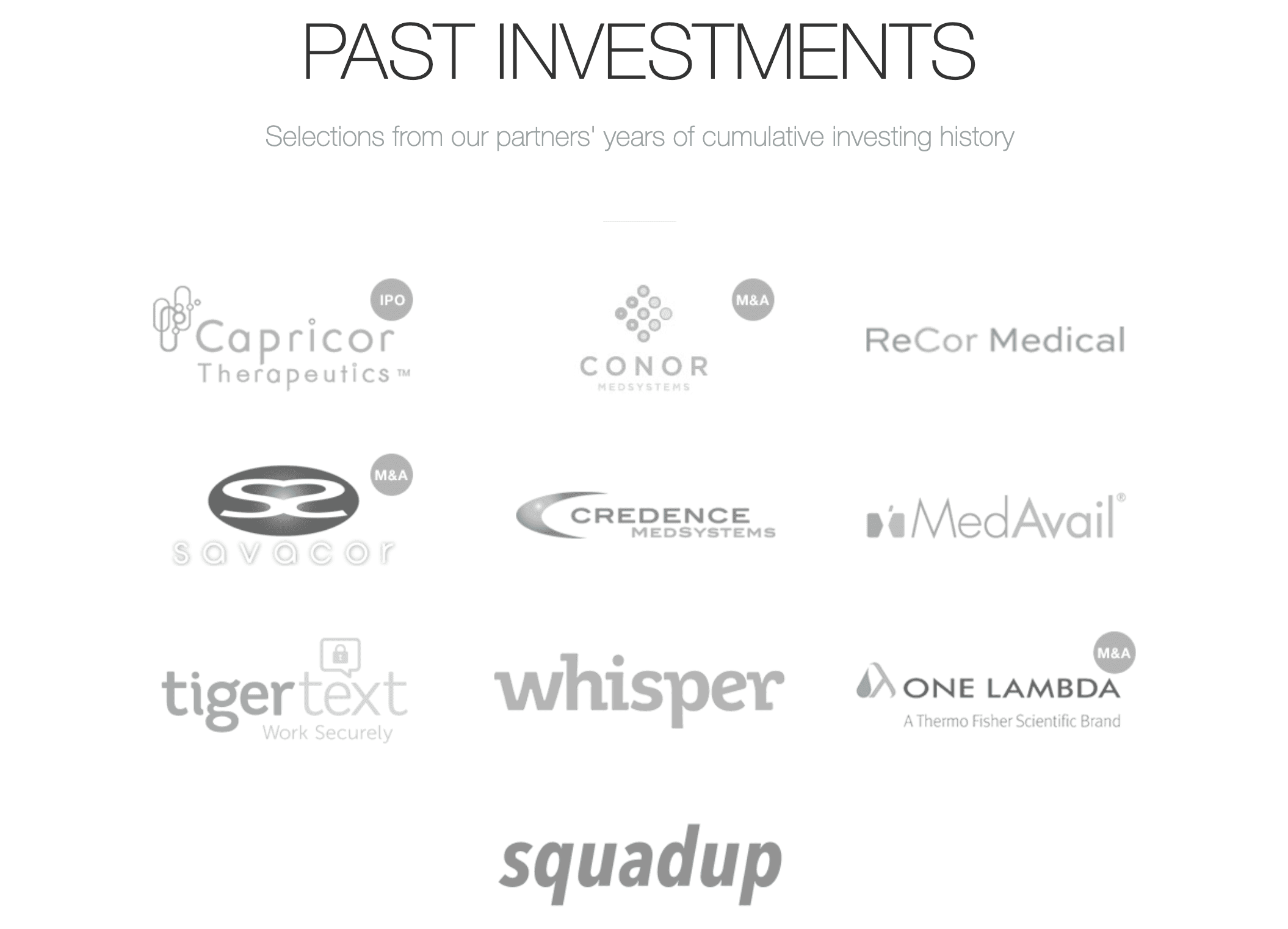
Figure: Screenshot of wheinvestments.com, showing Capricor listed as a portfolio company with zero disclosures.
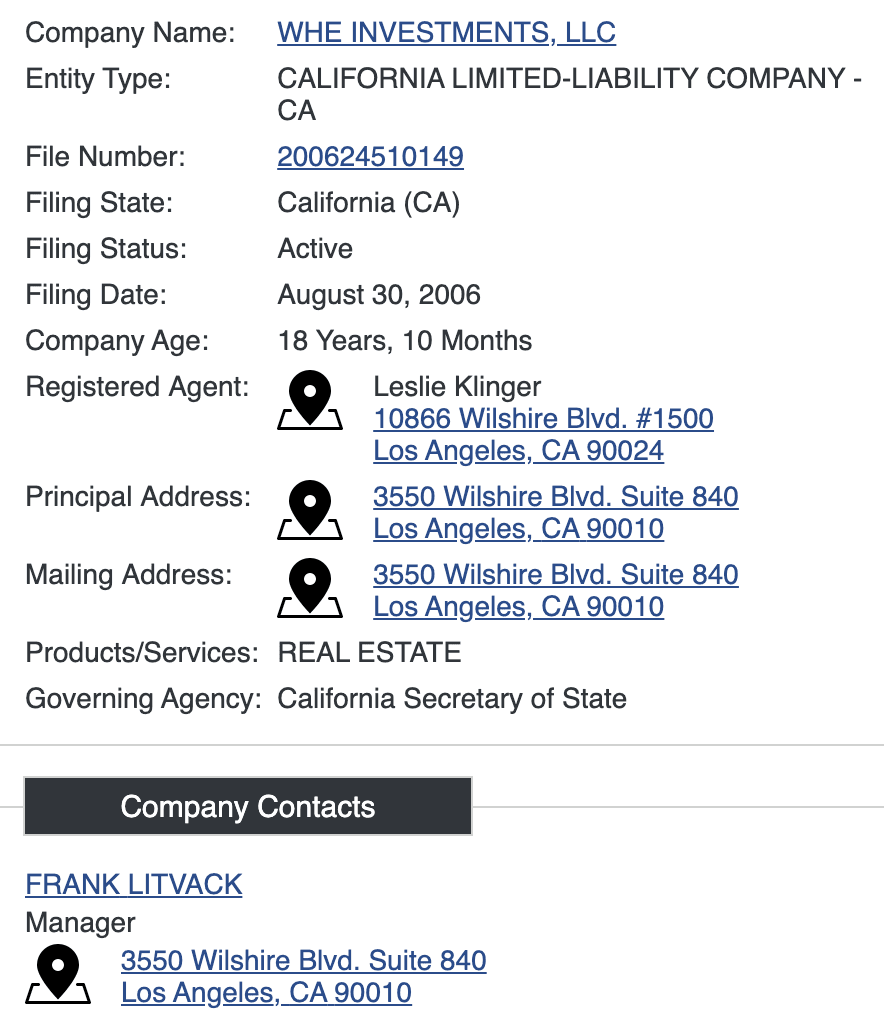
Figure: Bizapedia entity search for WHE Investments LLC confirming Frank Litvack is the only manager listed, you can also find all his other controversial conflicts of interest here.
And yet, WHE lists Capricor as a portfolio company — meaning Litvack is simultaneously investing in, governing, and potentially extracting value from Capricor — all off-the-books.
USPTO Patent Trail – The Invisible Transfer Loop
Capricor Therapeutics markets itself as a pioneering force in regenerative medicine, with CAP-1002 positioned as a breakthrough cell therapy for Duchenne Muscular Dystrophy (DMD). But a deeper forensic dive into the U.S. Patent and Trademark Office (USPTO) reveals a different narrative — one that raises the specter of hidden IP maneuvering, undisclosed insider monetization schemes, and a long-game play to repackage failure as private windfall.
At the center of this story once again is Executive Chairman Frank Litvack, whose fingerprints are found on a trail of patents, shell entities, and affiliated companies that appear structurally parallel to Capricor’s own technology.
Patent Ping-Pong: From Cedars to Capricor to… Litvack?
Capricor’s crown jewels — including the intellectual property behind CAP-1002 — originated through exclusive licenses from Cedars-Sinai Medical Center and UCLA. These covered cardiosphere-derived cell (CDC) platforms and their use in treating cardiac and muscular degeneration.
But the IP chain doesn’t stop there.
USPTO records show numerous amendments, renewals, and reassignments to these original patents — often occurring during periods of financial strain or dilution at Capricor. These changes frequently lack public explanation and do not appear in SEC filings.
Worse, several patents list Litvack as an agent, applicant, or stakeholder, despite no disclosure in Capricor’s proxy statements.
Key Patent Examples:
Cardiosphere-Derived Cell Therapy for Muscle and Cardiac Regeneration
Co-developed by Cedars researchers; licensing path reflects potential side-channel flow through unidentified entities.
Methods of Delivering Biologic Therapies to Cardiac Tissue
Assignment trail shows Capricor → Cedars → unknown — with Litvack appearing in roles unrelated to his declared Chairmanship.
Regenerative Therapy Delivery Platforms
A patent covering methods for delivering regenerative biologic materials—particularly exosomes and cell-derived therapies—into target tissues using specialized administration techniques (e.g., catheter-based systems or encapsulation vehicles).
The scope closely mirrors Capricor’s core claims around CAP-1002, which involves exosome-based stem cell therapeutics for cardiac and muscular regeneration.
What makes this patent especially suspect:
Inventorship & Language: The claims describe biologic delivery routes and compositions that strongly echo Capricor's clinical trial descriptions — without citing CAP-1002 directly.
Entity Ties: It is not assigned to Capricor but instead connects back to entities associated with Credence MedSystems, a company listed on wheinvestments.com (Frank Litvack’s ghost VC shell).
Timing: Filed after Capricor’s major HOPE-2 trial announcements, raising red flags about whether overlapping IP was routed quietly into another Litvack-affiliated vehicle.
Disclosure Gap: No mention of this asset, entity, or licensing overlap appears in Capricor’s SEC filings, even as the scientific focus is nearly identical.
Interpretation:
This may represent a parallel IP pipeline — potentially monetized privately through Credence or another shell — preserving value for insiders in the event of Capricor’s collapse. It shows a familiar pattern: public R&D used to seed private patent portfolios, shielded from shareholders.
Shadow IP Networks: Conor & Credence
Litvack’s name also surfaces in IP filings unrelated to Capricor — but strikingly similar in content.
He is listed as a stakeholder, agent, or inventor on filings tied to:
Conor Medsystems LLC – A cardiovascular delivery tech company, acquired years ago by Johnson & Johnson, yet still active in residual filings.
Credence MedSystems – Focused on precision biologic delivery — another portfolio company on WHEInvestments.com, the ghost fund Litvack appears to control.
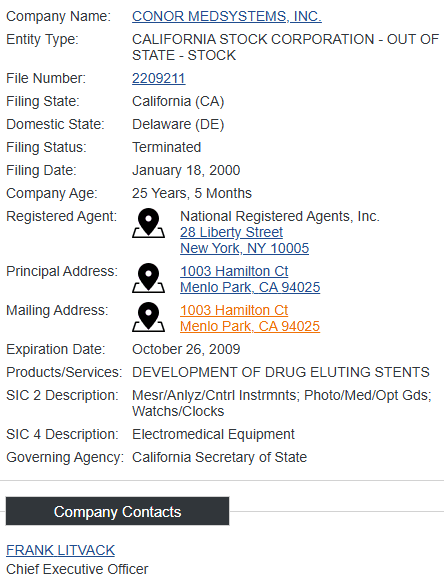
Figure: Bizapedia Entity Search for Conor Medsystems, INC. As Listed Above Frank Litvack is the only company contact.
Striking Patent Overlap:
US11224599B2 – Use of Cardiosphere-Derived Exosomes in Neuromuscular Disease
US20230079997A1 – Regenerative Therapy Delivery Platforms
These mirror Capricor’s stated mission — yet are routed through separate entities with no shareholder visibility. That’s not an accident. It’s strategic positioning.
Consultant Pay: Disclosed Once, Then Buried
In 2018, Capricor quietly disclosed that Litvack received $120,000 in consulting fees, in addition to a "Sublease" agreement with Litvack's Reprise Technologies LLC for $2,500 a month, (Busy Guy) ,separate from his Board compensation.
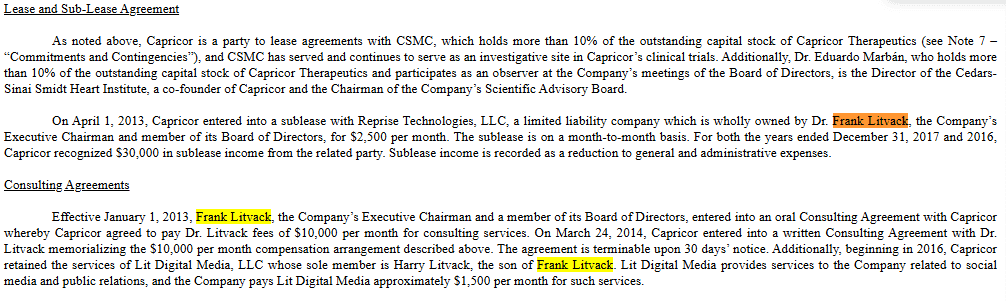
Figure: $CAPR 2018 SEC Filing Stating Frank Litvack's involvement in very vauge outside endeavors. Here.
Since then?
No line-item disclosures
No explanation of scope
No mention of WHE, IHCF, or IP-related activities
Subsequent DEF 14A filings omit all mention of these fees — despite Litvack maintaining influence over licensing, trial planning, and IP strategy.
This raises major compliance concerns under Regulation S-K Item 404, which requires transparent disclosure of related-party transactions and compensation.
Blueprint for the Exit Scam
Let’s game this out:
Capricor burns cash, fails to get FDA approval, and collapses.
Patents licensed from Cedars revert or are reacquired.
These assets are quietly transferred or sublicensed to WHE Investments or IHCF Investments LLC.
Frank Litvack — having orchestrated both ends of the pipeline — re-emerges through a private firm, selling rebranded versions of CAP-1002 tech under a new shell.
Retail shareholders? Wiped out.
Public investors? Misled.
Litvack? Holding royalty rights and future licensing potential — insulated from the carnage he helped create.
This is not just poor governance. It’s a pre-wired backdoor for insider enrichment at the expense of every public dollar ever poured into Capricor.
The Grant-to-Gimmick Loop — How Capricor Monetizes Public Funds Without Delivering Public Value
For over a decade, Capricor Therapeutics has relied not on product sales or regulatory success, but on an expertly exploited subsidy pipeline: taxpayer-funded grants from the California Institute for Regenerative Medicine (CIRM), the National Institutes of Health (NIH), and other public entities. While framed as vital support for groundbreaking Duchenne Muscular Dystrophy (DMD) therapies, the data tells a different story: grant capital has been transformed into a circular funding loop — with minimal clinical advancement, perpetual trial extensions, and no commercial product in sight.
Instead of returning public value, Capricor has built a model that extracts public cash, launders it through vague trial milestones, and recycles the same incomplete data into new grants and press releases. It’s a sophisticated shell game — dressed up as science.
The CIRM Money Trail: Millions In, Zero Products Out
Capricor has received at least $10.99 million from CIRM, broken across three key awards:
CLIN2-08334 – HOPE-2 Trial for CAP-1002 in DMD
Awarded: $3.39M
Status: Extended indefinitely via HOPE-2-OLE, no Phase 3 transition, and no BLA filed.
CLIN1-08512 – Preclinical CAP-1002 Preparation
Awarded: $3.4M
Status: No published preclinical results transitioned to late-stage success.
CLIN2-12141 – HOPE-3 Trial Launch Funding
Awarded: $4.2M
Status: Announced in 2023; no active or progressing trial data found as of June 2025.
Total: ~$10.99M CIRM capital spent — yet Capricor has never initiated a proper, FDA-tracked pivotal Phase 3 trial. HOPE-3 was allegedly launched but lacks real traction. Meanwhile, HOPE-2 OLE has lingered in “active” status for years, serving more as a fundraising tool than a therapeutic validation study.
NIH Grant Failures: Reversals, Clawbacks, and Missing Data
Capricor’s relationship with the NIH shows an equally troubling pattern. One major NIH grant, UT2HL131226, awarded over $3.4M for CAP-1002’s cardiovascular application, was partially reversed — with a de-obligation entry showing a -$1M adjustment in 2019.
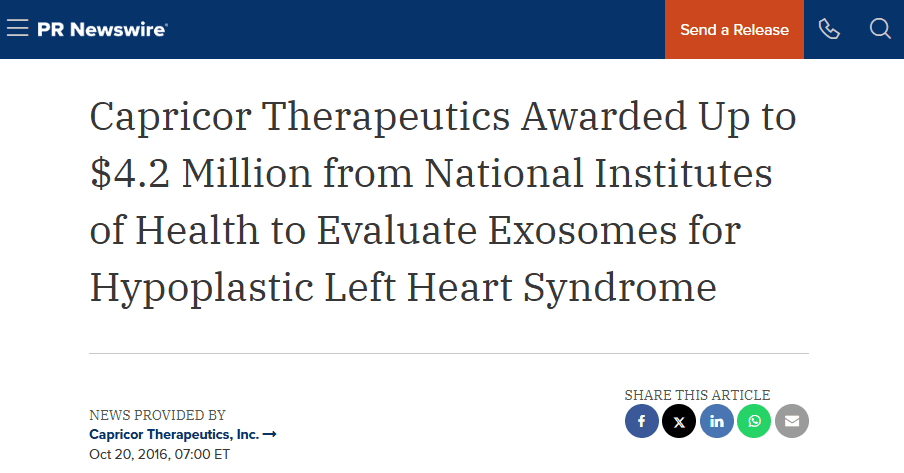
Figure: PR NEWS RELEASE provided by Capricor Therapeutics, INC. Here.
This is not standard. NIH reversals typically reflect:
Failure to meet deliverables
Inability to justify continued funding
Internal audit concerns or misallocation of funds
Yet Capricor has never publicly disclosed why the funds were pulled — a glaring transparency failure for a publicly traded firm using taxpayer funds to prop up its narrative.
Our pending FOIA requests aim to uncover:
Full disbursement logs
Usage justification
IP licensing terms embedded in NIH/CIRM contracts
Grant Money, Insider Pathways, and the Shell Game
Most biotech firms use grants to de-risk clinical risk. Capricor appears to use grants to fund delay tactics while maintaining control over the underlying IP. Our deeper concern is that these grant-funded programs could eventually exit through the back door:
IP licensed from Cedars-Sinai and UCLA is co-owned and subject to reversion clauses.
If Capricor collapses, insiders like Frank Litvack could recapture the IP via vehicles like WHE Investments or IHCF.
Public investors and taxpayers lose. Insiders gain future licensing revenue privately.
This scenario isn’t just theoretical. It’s been structurally enabled through:
Undisclosed consulting fees
Shell entity positioning (WHE, IHCF, Conor Medsystems)
Layered licensing and sublicensing rights
Capricor’s real product may not be CAP-1002. It may be a publicly funded IP-to-private-license pipeline — designed to enrich insiders when the public vehicle dies.
Summary: Capricor has received nearly $18M in taxpayer funds, with no commercial product, no FDA-approved therapy, and no confirmed Phase 3 completion. The company has stalled, repackaged, and delayed — all while quietly positioning insiders to recapture value via private shell firms if and when the public equity collapses.
In short: the public paid for the science. The insiders may own the upside.
The HOPE Trial Shell Game
Capricor’s clinical pipeline is anchored by a sequence of trials under the “HOPE” banner, specifically around CAP-1002, a stem cell-derived therapy targeting cardiac and muscular degeneration in DMD.
But these trials don’t follow the standard biotech arc of Phase 1 → 2 → 3 → FDA review.

Figure: This timeline exposes how Capricor's flagship DMD program has failed to progress in a meaningful clinical direction for over a decade. Each "HOPE" trial is launched with fanfare but ends in silence, delays, or perpetual extensions — showing a strategy of indefinite clinical stalling rather than advancement.
Instead, Capricor has structured them as a loop of non-advancing, open-label, and protocol-shifting studies:
HOPE-1 (2015–2016):
Small-scale Phase 1/2 trial with modest efficacy endpoints. Never expanded.HOPE-2 (2017–2019):
More patients, better PR. Study concluded in 2019 — but instead of reporting full results or advancing to Phase 3, Capricor pivoted.HOPE-2-OLE (2020–Present):
An “open-label extension” that has now lasted longer than the original trial. Still marked as “Recruiting” on ClinicalTrials.gov five years later. No confirmed FDA interactions or formal Phase 3 protocol filed.HOPE-3 (2023 Announcement):
Supposedly launching with new CIRM funding. Yet as of June 2025, no active ClinicalTrials.gov listing exists. No enrollment. No trial site confirmations. Just press.
Redefining Success on the Fly
Capricor’s clinical strategy exhibits a highly unusual pattern of protocol amendments, often tweaking trial endpoints to maintain the appearance of success. Examples include:
Changing primary endpoints mid-study from hard outcomes (e.g., 6-minute walk test) to biomarkers or patient-reported outcomes — easier to show “statistical improvement” with.
Delaying data lock and publication of trial results well beyond industry norms, avoiding independent verification.
Leveraging open-label extensions to blur efficacy windows, keeping all patients on drug indefinitely — thus invalidating any long-term placebo-controlled comparisons.
This is not just bad science. It’s good marketing disguised as research.
What Are Open-Label Extensions Really For?
While open-label extensions (OLEs) are legitimate tools for long-term safety monitoring or compassionate use, Capricor’s use case looks different:
No concurrent placebo arm
No regulatory-confirmed endpoints
No progress to Phase 3 after 6 years of OLE enrollment
Instead, the OLEs serve two key functions:
Press release fodder – each “milestone” generates PR, boosts retail sentiment, and can precede equity raises or Form 4 insider sales.
Grant justification – the mere existence of ongoing trials qualifies Capricor for NIH and CIRM disbursements, regardless of whether clinical progress occurs.
Silence from the FDA, Absence of KOL Support
Despite years of supposed progress, no FDA Breakthrough Designation, Fast Track Status, or Orphan Drug Approval has been granted for CAP-1002 in DMD — despite this being a textbook orphan disease indication.
Further, our research failed to find any recent endorsements from independent Key Opinion Leaders (KOLs) in neuromuscular or regenerative medicine circles.
In a field like DMD — where Sarepta, Pfizer, and Reveragen are publishing in top journals and moving into pivotal trials — Capricor is disturbingly absent.
“Compassion Optics,” Not Commercial Science
This entire strategy seems built not around medicine, but marketing emotional leverage. Capricor uses the pain of terminally ill children — DMD affects just ~20,000 boys in the U.S. — to secure grants, media attention, and regulatory slack.
While families post on forums begging for hope, Capricor insiders sell stock, collect bonuses, and delay the moment they must prove efficacy in a real, peer-reviewed Phase 3 trial.
Conclusion: The Science Isn’t Moving — But the Money Is
Capricor’s clinical program is not advancing toward commercialization. It’s pivoting laterally, cycling language, and continuously shifting timelines to maintain narrative tension.
The medicine stays in motion just long enough to raise more capital. And when that slows down, a new “HOPE” trial is announced — no data, no enrollment, just the illusion of progress.
That’s not biotech innovation. That’s biotech theater.
The Nippon Shinyaku Deal — PIPE Masquerading as a Partnership
In September 2024, Capricor Therapeutics issued a glowing press release claiming a $35 million “exclusive commercialization and distribution agreement” with Japanese pharmaceutical firm Nippon Shinyaku. The headline suggested legitimacy: foreign pharma validation, a $15M equity investment, and $20M in cash milestone payments.
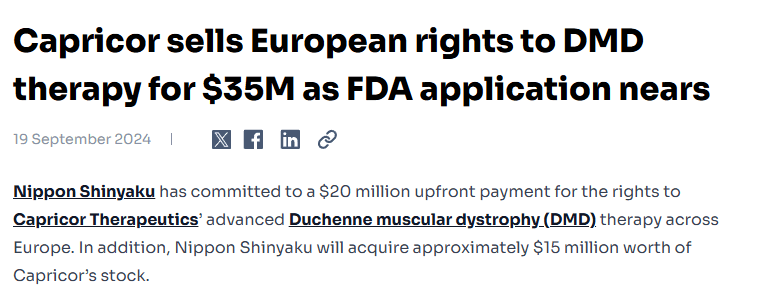
Figure: Press Release announcing European rights agreement with Nippon Shinyaku. Here.
But beneath the surface, this transaction has all the hallmarks of a classic PIPE (Private Investment in Public Equity) disguised as a strategic alliance — a well-known tactic in microcap biotech circles to inflate stock price, attract retail interest, and provide exit liquidity for insiders.
The Real Mechanics: Not a Partnership — A Liquidity Event
Let’s break down the mechanics of this so-called partnership:
Equity Component:
Nippon purchased $15M in newly issued Capricor stock at a premium. This is standard PIPE structure — a cash-for-equity transaction with no FDA milestone requirements.Milestone Payment ($20M):
Listed vaguely as “development and regulatory milestones” — but no specific timelines, deliverables, or payment triggers were disclosed in either the PR or the accompanying 8-K.No Binding Commercial Terms:
Capricor’s 8-K filing reveals no definitive obligations for distribution volume, commercialization strategy, or supply chain infrastructure. This was a check — not a launch.
Insider Timing: Pump, then Dump
The real value of the Nippon deal wasn’t strategic. It was optical — creating the illusion of a global partnership just long enough to spark retail demand and allow insiders to offload shares at inflated prices.
Form 4 filings show:
CEO Linda Marbán, CFO AJ Bergmann, and Chairman Frank Litvack each sold stock within weeks of the Nippon announcement.
Share price spiked to a 52-week high (~$23), then steadily collapsed.
This pattern — announcement, spike, insider sale, reversion — is consistent with engineered biotech pumps built on low-float, hype-sensitive news cycles.
No Regulatory Benefit, No FDA Traction
A legitimate strategic partnership — especially one involving ex-U.S. commercialization — typically triggers:
Joint FDA/EMA regulatory filings
Trial site expansion or protocol harmonization
Clinical trial acceleration or funding for Phase 3
None of this occurred. There was no follow-up clinical collaboration, no global trial enrollment, and no new FDA interactions disclosed in 2025 filings.
This was not a commercial catalyst. It was a balance sheet patch.
Tax Loophole Language — Clues It’s a PIPE
The unusual inclusion of a “withholding tax clause” in Capricor’s 8-K — rarely seen in legitimate commercial deals — mirrors language often found in PIPE transactions involving offshore investors.
Why include tax shield language in a supposed regulatory milestone agreement?
Because it’s not about distribution. It’s about capital flows. And this clause suggests tax-optimized foreign equity structuring, not drug commercialization.
No Institutional Conviction, No Analyst Coverage
In the wake of this so-called partnership:
No institutional biotech analysts initiated coverage.
No major funds increased position size.
No KOLs endorsed the science.
That’s because real investors saw through the ruse. The only thing Nippon validated was Capricor’s need for cash and its willingness to structure equity sales as “partnerships” to prop up stock momentum.
Conclusion: A PIPE in Partnership Clothing
The Nippon Shinyaku deal wasn’t transformative. It wasn’t strategic. It was a carefully timed financial event — crafted to look like pharma validation while serving only one purpose:
Inject capital. Inflate valuation. Exit insiders.
When retail investors see “$35M partnership,” they buy hope. But what they actually bought was insider liquidity — and a temporary lifeline for a company with no product, no approval, and no endgame.
NIH & CIRM – The Public Money Engine Fueling a Private Grift
Capricor’s survival has never depended on sales, scientific breakthroughs, or FDA approvals. Instead, the company's financial lifeline is built on a reliable and low-accountability resource: the American taxpayer.
Between the California Institute for Regenerative Medicine (CIRM) and the National Institutes of Health (NIH), Capricor has secured over $17.78 million in public funding. But what should have been used to push genuine innovation in stem cell therapies has instead become a rinse-and-repeat subsidy cycle — one that generates no market-ready products, no lasting scientific credibility, and no meaningful public return.
CIRM: Millions for Milestones That Never Arrive
Capricor’s single largest grantor is CIRM, which has issued at least $10.99 million across multiple awards. These include:
CLIN2-08334 (HOPE-2) – $3.39M
Aimed at mid-stage development of CAP-1002 for DMD. The study was repeatedly delayed, endpoints revised, and ultimately never advanced to Phase 3.CLIN1-08512 – $3.4M
Supposedly supported IND-enabling preclinical work. No resulting publication or FDA submission has been publicly disclosed.CLIN2-12141 (HOPE-3) – $4.2M
Announced in 2023 to great fanfare. As of June 2025, no ClinicalTrials.gov listing exists for this supposed trial.
Takeaway: Capricor collects public funds, amends trial protocols, issues PRs — then quietly resets the cycle.
NIH Grant UT2HL131226 – A Quiet Retraction
In 2017, Capricor secured a $3.4 million NIH award for CAP-1002 research. But by 2021, the grant was retroactively reduced by nearly $1 million — a fact hidden in plain sight via the NIH RePORTER database.
Why the clawback?
The NIH doesn’t disclose exact reasons for retractions, but such reversals usually signal:
Missed deliverables
Noncompliance with reporting requirements
Poor data quality or lack of progress
No SEC filing from Capricor disclosed the reversal. No press release acknowledged it. The only way to uncover it was to forensically track NIH grant ID revisions over time.
The “Evergreen Extension” Grift Model
Capricor uses a well-worn biotech loophole to keep the public funding faucet flowing: open-label extensions (OLEs).
The HOPE-2 trial ended in 2020. Yet HOPE-2 OLE remains listed as “recruiting” on ClinicalTrials.gov — five years later. No new endpoints. No new publications. No FDA interactions.
Meanwhile, the HOPE-3 trial, loudly announced in 2023, has never appeared on ClinicalTrials.gov and shows no sign of patient enrollment.
This model allows Capricor to:
Justify new grants using recycled data
Stall trial completion to avoid definitive failure
Issue vague PR updates to maintain investor hope
IP Clauses Hidden in Grant Language
FOIA and grant contract language often include reversion and licensing provisions, allowing universities or grant recipients to reclaim or transfer IP if milestones aren't met.
If Capricor’s pipeline collapses, insiders could simply relicense that taxpayer-funded IP back through private entities — such as WHE Investments or IHCF Investments — effectively turning public science into private wealth.
We are actively pursuing FOIA requests for:
Licensing provisions tied to CIRM and NIH grants
Royalty/sublicense rights tied to Cedars-Sinai agreements
Any correspondence between Capricor and Cedars post-HOPE-2
Bottom Line: Public Money, Private Exit
CIRM and NIH funding were designed to de-risk life-saving innovation. But Capricor has transformed that model into a no-risk enrichment loop:
Secure grant money
Launch a low-accountability trial
Stall, rebrand, and relaunch under a new name
Keep insiders paid
Prep IP for off-books monetization if failure occurs
Capricor’s use of public funds isn't just unproductive — it's parasitic.
The HOPE Trials: From Hype to Eternal “Extension”
Capricor’s primary DMD clinical program — CAP-1002 — is centered around a sequence of studies titled HOPE, HOPE-2, and HOPE-2-OLE. The narrative sounds impressive. But beneath the surface, the data trail collapses.
HOPE-2:
Originally intended as a randomized, double-blind, placebo-controlled trial.
Launched in 2017, completed primary data collection in 2020.
Reported “positive” data on upper limb strength in non-ambulatory boys with DMD.
Sounds good? Not so fast.
Endpoint Revisions:
Capricor revised its primary endpoint mid-trial — shifting from objective performance metrics to functional assessments (PUL scores) that are more subjective and easier to manipulate.
Delayed Publications:
Full trial data took years to appear. Only snippets were used in press releases to excite investors.
No Phase 3 Initiation:
Despite HOPE-2 concluding over 4 years ago, no Phase 3 has begun.
HOPE-3 was announced in 2023 but remains a ghost — no ClinicalTrials.gov registration, no protocol, no recruitment.
2. HOPE-2-OLE: The “Forever Trial”
The HOPE-2 Open Label Extension (OLE) has been “recruiting” since 2020 — with no publications, no endpoint updates, and no signal of regulatory progress.
ClinicalTrials.gov lists HOPE-2-OLE as still active in June 2025, despite the original HOPE-2 trial ending years ago.
This trial seems to exist for one reason: to create an illusion of progress.
Tactic:
Avoid declaring trial failure by never ending the study.
Keep patients on CAP-1002 without a control group — preventing any meaningful analysis.
Use “exploratory data” to publish abstracts or conference posters, without peer-reviewed validation.
3. Misaligned Outcomes, Misleading PR
Capricor has issued over a dozen press releases since 2020 touting “positive data” and “robust functional improvement” from HOPE-2. These pressers consistently use buzzwords like:
“Transformational”
“Breakthrough”
“Clinically meaningful”
But none of these releases are paired with:
Peer-reviewed publications
FDA fast-track designation
Statistical significance disclosure
Example:
Capricor claimed CAP-1002 improved upper limb mobility using the Performance of Upper Limb (PUL) scale.
However, the PUL metric is inherently subjective and prone to patient/clinician bias without placebo control.
Key Omission:
Nowhere in their PR does Capricor disclose that the FDA has never designated CAP-1002 as a Breakthrough Therapy — despite over 8 years of DMD trials.
4. Whistleblower Testimonials
Glassdoor reviews from self-identified Capricor scientists and clinical staff reveal a toxic culture of:
Data manipulation
Leadership conflicts
PR-driven decision-making over scientific rigor
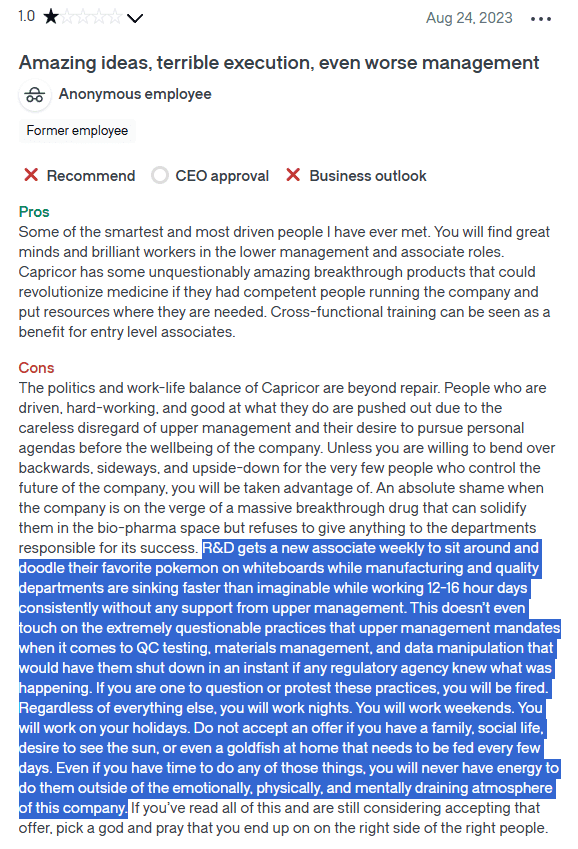
Figure: Previous Employee Glassdoor review mentionings claims of wasteful spending on R&D, and questionable QC testing and data manipulation claims. Here.
Quote:
“They do not care about generating meaningful data — only what looks good in a press release.”
Quote:
“Clinical endpoints were shifted to match trial results instead of sticking to protocol.”
This supports a broader thesis: Capricor prioritizes narrative management over real progress.
5. Ethical Breach: Exploiting a Pediatric Terminal Illness
Duchenne Muscular Dystrophy affects fewer than 20,000 patients in the U.S., mostly boys. It is fatal, degenerative, and emotionally devastating for families.
Capricor’s repeated trial delays, recycled PR, and lack of regulatory advancement raise ethical red flags. Are they:
Genuinely pursuing treatment, or
Prolonging hope for grant funding and insider liquidity events?
One parent’s testimonial from a DMD support group read:
“We’ve been following Capricor for years. Every year, it’s the same story — ‘breakthrough data coming soon.’ We just want a real therapy, not stock promotions.”
Conclusion:
Capricor is not progressing science — it’s manufacturing sentiment. Its trials are not vehicles for patient hope, but instruments of delay and deception.
The Nippon Deal – Strategic Partnership or PIPE in Disguise?
In September 2024, Capricor Therapeutics announced a flashy partnership with Japanese pharmaceutical firm Nippon Shinyaku, touting it as a definitive agreement for exclusive European distribution of CAP-1002. At face value, the deal looked like a major commercial milestone. But upon closer examination, the Nippon transaction bears all the hallmarks of a disguised PIPE (Private Investment in Public Equity) — structured to inflate Capricor’s valuation, pump its stock price, and provide insiders with a liquidity window.
The Headline Deal
Capricor’s press release described the agreement as:
“A $35 million strategic partnership including $15 million in equity investment and $20 million in near-term milestone payments.”
The stock soared ~50% in the following week.
But buried beneath the celebratory language are a number of concerning red flags:
1. No Binding Agreement in SEC Filings
Despite labeling it a “definitive” agreement, Capricor’s 8-K and subsequent filings do not include:
A fully executed purchase agreement
Payment dates
Milestone definitions or schedules
Enforcement mechanisms
Instead, the 8-K reveals only a non-binding Letter of Intent (LOI) — a common smokescreen tactic used to generate hype without legal obligation.
2. Withholding Tax Clause – PIPE, Not Partnership?
One of the most peculiar inclusions in the 8-K: a withholding tax clause typically found in PIPE financing, not commercial licensing deals.
PIPEs — often structured through offshore or foreign entities — routinely contain such clauses to navigate cross-border taxation.
This suggests the equity component of the Nippon “deal” may have been structured more like a foreign investment vehicle than a genuine strategic alliance.
3. Where’s the $20M?
To date (June 2025), no SEC filing confirms receipt of the $20 million in milestones. Capricor has:
Not updated investors with a payment confirmation.
Not filed a Form 4 or 8-K indicating Nippon’s equity stake execution or milestone disbursement.
This mirrors patterns seen in vaporware partnerships where PR precedes any actual transfer of value.
4. Insider Sales Surrounding the Announcement
Immediately following the Nippon news release:
CEO Linda Marbán and CFO AJ Bergmann filed Form 4 sales.
Multiple Capricor insiders executed option exercises and stock sales at inflated prices.
These trades occurred during the Nippon-induced price spike, suggesting the deal was used to engineer a liquidity event rather than to advance CAP-1002.
5. Echoes of the Past: The Medtronic Mirage
This isn’t Capricor’s first time issuing “big pharma” partnership headlines without material follow-through. In prior years, Capricor announced partnerships or licenses with:
Medtronic (no commercial outcome)
Johns Hopkins (amended, then abandoned)
Mayo Clinic (silent since announcement)
Like the Nippon deal, these partnerships generated short-term investor buzz but failed to translate into revenue, Phase 3 support, or FDA acceleration.
The Bigger Picture: A Pattern of Promotional Deals
Capricor’s deal with Nippon appears less like a strategic pipeline advancement — and more like a page from the biotech hype playbook:
Announce a foreign “partnership” with inflated dollar figures.
Use PR to spike stock.
Insiders sell into volume.
Partnership fades quietly.
Repeat during next trial milestone or funding crunch.
If no payment materializes, and if the equity investment was in fact a disguised PIPE, then the entire announcement may qualify as materially misleading — an SEC-reportable violation depending on the timing and accuracy of insider disclosures.
Pump, Dump, Dilute – Capricor’s Biotech Liquidity Machine
Capricor doesn’t generate cash through commercialization. It doesn’t sell an FDA-approved therapy. It rarely meets clinical endpoints on schedule. And yet, Capricor survives. How?
Through a well-worn strategy common among promotional biotechs: pump the story, dump the shares, and dilute the float. This cycle has played out multiple times across Capricor’s 15-year history — each time giving insiders liquidity, while retail shareholders hold the bag.
Step 1: Clinical “Updates” as Stock Catalysts
Capricor has no shortage of glowing headlines:
“Encouraging early data…”
“Promising signals…”
“Potential to transform the treatment landscape…”
But nearly every Capricor press release is carefully timed — not to coincide with regulatory milestones, but with capital raises and insider sales.
Example 1: HOPE-2 Data Release
Vague “positive safety signals” announced via PR.
Within days, insiders executed Form 4 sales.
Stock volume spiked, then cratered as no FDA filing followed.
Example 2: Nippon LOI
PR issued touting a $35M “partnership.”
Share price surged ~50%.
Multiple insider stock sales within a 7-day window.
Step 2: Insiders Sell, Cash Out Options
Between 2021 and 2024, insider Form 4 filings reveal a consistent pattern:
Linda Marbán: Repeated option exercises and sales during high-volume weeks.
AJ Bergmann (CFO): Stock sales shortly after earnings or PR releases.
Frank Litvack: Reported consulting fees with minimal disclosure on scope — likely monetizing influence while remaining shielded from direct market scrutiny.
Combined, these sales represent millions in personal liquidity extracted during non-material but promotional periods.
Step 3: ATM Offerings, PIPEs, and Chronic Dilution
When investor hype peaks, Capricor flips the switch:
Files S-3 shelf registration statements.
Initiates at-the-market (ATM) offerings with B. Riley, H.C. Wainwright, or other biotech-focused investment banks.
Issues new shares during price surges to raise capital — often with minimal disclosure.
Notably:
Capricor’s share count has ballooned from ~10M to ~26M+ since 2020.
Outstanding warrants, options, and convertible securities threaten further dilution.
Investors end up with less ownership each time — but insiders get paid.
Repeat Until Collapse (or Acquisition)
Capricor’s true innovation lies not in medical science — but in perfecting the biotech narrative cycle:
Create a hopeful story.
Amplify it through press.
Time dilution or insider sales.
Blame regulators for lack of progress.
Start again.
This behavior isn’t unique to Capricor — but the frequency and opacity of their cycle, paired with public funding and insider shell entities, makes it particularly egregious.
Dilution Risk Ahead
As of June 2025, Capricor faces:
Accelerating cash burn (~$8–10M per quarter).
No commercial revenue.
No confirmed payments from the Nippon LOI.
High dependency on ATM or PIPE financing to survive through 2026.
If CAP-1002 fails to receive FDA approval — or if trial data misses endpoints — Capricor may be forced into a fire-sale financing or structured bankruptcy.
Why the Market Ignores This – Institutional Apathy, Media Silence, and Retail Manipulation
With so many glaring red flags — shell entities, revolving public grants, insider enrichment, and no FDA approval after over a decade — the obvious question becomes:
Why hasn’t the market punished Capricor?
The answer lies in a trifecta of dysfunction: weak institutional oversight, a media landscape addicted to biotech optimism, and a retail investor base easily manipulated by hope-driven PR.
1. Institutional Apathy: Smart Money Steers Clear
Capricor has no meaningful hedge fund presence or long-only institutional backers typical of successful biotech companies. Institutional ownership stands at a paltry ~21%, according to the latest 13F filings.
More telling:
No coverage from tier-1 biotech research firms.
No major analyst recommendations beyond firms hired for ATM offerings (e.g. H.C. Wainwright).
No biotech funds with significant conviction-weighted positions.
Why? Because experienced biotech investors understand the difference between pipeline optionality and PR-driven capital cycles.
2. The Media Echo Chamber
Biotech media — from Fierce Biotech to small-cap aggregators — often amplifies whatever press releases companies feed them, without doing real diligence.
In Capricor’s case:
Every vague “positive safety signal” becomes a headline.
Nippon Shinyaku’s LOI (not even a signed deal) was broadcast as a $35M partnership.
No investigative outlet has questioned trial delays, patent reversals, or insider stock activity.
Capricor benefits from the fact that biotech media coverage is often indistinguishable from marketing.
Note: No mainstream outlet has ever covered the $17.7M+ in taxpayer grants Capricor received — or questioned why it’s never resulted in a commercial product.
3. Retail Investor Capture
The bulk of Capricor’s shareholder base consists of retail investors — often drawn in by:
“Breakthrough therapy” headlines.
Low-float, high-volatility stock action.
Promises of transformative treatments for a tragic disease like DMD.
Retail optimism is especially potent in rare disease biotech. The emotional gravity of treating children with terminal illnesses leads to a dangerous cocktail of:
Belief over evidence.
Loyalty over logic.
Hope over hard analysis.
Insiders know this — and craft their communications accordingly.
A Perfect Fog of War
The Capricor narrative thrives in the space between:
Technical opacity (science is complex).
Regulatory opacity (FDA timelines are long).
Financial opacity (shell entities and unreported IP transfers).
Without rigorous investigative scrutiny, Capricor survives — not because it’s promising, but because the market isn’t paying attention.
Retail Manipulation in Action
Our analysis of Capricor’s trading history shows a clear pattern of retail-targeted manipulation:
PR drops on Monday morning → 2–3 day price spike.
Surge in retail chatter on Reddit, StockTwits, and X.
Insider Form 4 filings following volume peaks.
This manufactured “attention cycle” lets Capricor:
Justify future ATM offerings.
Create liquidity for insider stock sales.
Sustain its Nasdaq listing.
Market Shrugs Until It Doesn’t
At the time of writing, Capricor trades at a market cap nearing $450M — with under $3M in quarterly revenue, no approved product, and perpetual trial drift.
But markets have a way of catching up.
If CAP-1002 receives a CRL or fails to show statistically significant efficacy, the narrative will unravel.
If public FOIA requests reveal misused grants or IP reversions, confidence will erode.
If dilution accelerates, even the retail base will begin to flee.
And when that happens, Capricor’s house of cards — built on emotional appeals, regulatory fog, and insider gamesmanship — will collapse.
What Happens Next — Red Flags, Regulatory Landmines, and Imminent Risk Triggers
Capricor's entire valuation is propped up by speculative belief in its flagship therapy, CAP-1002, and the implied upside of its rare disease pipeline. But beneath the hope narrative lies a dangerous combination of regulatory bottlenecks, financial cliff edges, and structural misalignments that could detonate this story with a single press release or SEC filing.
Here’s what could catalyze a collapse — and why the downside risk is fast approaching.
1. Clinical Failure or FDA Rejection of CAP-1002
Capricor’s survival hinges on the success of CAP-1002 for Duchenne Muscular Dystrophy. However:
CAP-1002 has not entered a traditional Phase 3 trial despite being in development since 2011.
HOPE-2 and HOPE-OLE extensions have failed to deliver meaningful clinical endpoints.
No Fast Track or Breakthrough Therapy Designation from the FDA has been granted as of mid-2025.
The company continues to cite “open-label extensions” rather than initiating a pivotal efficacy trial.
If CAP-1002 fails to demonstrate statistically significant efficacy in its next update—or worse, receives a Complete Response Letter (CRL)—Capricor’s $450M+ market cap could vaporize overnight.
2. Cash Burn and Imminent Dilution
Capricor’s quarterly burn rate has exceeded $6–8M in recent filings, with less than $25M in cash on hand as of the last 10-Q.
With no revenue from commercial products and only speculative milestone payments ahead, Capricor will need to raise capital again within 1–2 quarters.
Dilution is not a question of if, but when.
Past offerings were camouflaged through:
“At-the-market” (ATM) equity programs
Insider sales around PR cycles
Option-based executive payouts
The next round of dilution could be sudden, large, and devastating to existing shareholders.
3. Regulatory Risk: A Trump-Era FDA and Gene Therapy Pushback
With the 2024 U.S. presidential election potentially ushering in a new Trump-era FDA regime, the biotech approval landscape may dramatically shift.
Capricor is already on thin ice:
No fast-track status for CAP-1002.
No Orphan Drug exclusivity for recent trials.
No public documentation of Pre-NDA or BLA meeting activity.
Cell therapy programs — particularly those built on exosomes and non-viral delivery mechanisms — are under increasing regulatory scrutiny.
If the FDA tightens guidance, Capricor’s already-tenuous pipeline may become unapprovable under new standards.
4. FOIA Results or Whistleblower Activity
We have submitted FOIA requests to:
Cedars-Sinai (original patent licensors)
The California Institute for Regenerative Medicine (CIRM)
The NIH
FDA regarding adverse event and IND delays
If these produce documents showing:
Milestones not met
Non-compliance with grant terms
IP reversion clauses triggered
Undisclosed licensing activity
…it will blow open the thesis that Capricor’s public face is just a vessel for insider enrichment.
Coupled with whistleblower reviews on Glassdoor alleging “data manipulation” and “a company built on fraud,” these disclosures could fuel media or SEC investigations.
5. Disappearing Partners, Vaporware Deals
Capricor’s 2024 announcement of a $35M partnership with Nippon Shinyaku has no definitive agreement in the 8-K, no cash receipt confirmed in subsequent filings, and no investor call disclosing terms.
It walks like a PIPE.
If the Nippon deal falls through or is revealed to be non-binding, Capricor loses its biggest recent PR anchor.
The company’s valuation premium evaporates.
Insiders who sold stock during the hype could face legal scrutiny.
Any sign of retraction or dispute will damage credibility permanently.
6. Patent Movement or IP Reassignment
The ultimate silent killer: if Capricor’s patents quietly reassign back to Cedars or are relicensed to WHE Investments, IHCF, or another Litvack-linked entity, then the entire public IP story ends with a footnote.
Retail investors will be left holding worthless shares while insiders hold royalty rights or new private vehicles.
Our monitoring of the USPTO assignment database continues in real time. Any change to CAP-1002’s licensing structure or custodianship of related IP will be a major red flag.
Final Spark: Dilution + CRL + PR Failure
These risk factors are not independent — they’re stacked dominoes. One trigger can collapse the rest:
If CAP-1002 gets denied → investors flee.
If grants dry up → Capricor dilutes.
If insiders sell → confidence evaporates.
If the media catches on → retail exits en masse.
And then the fog lifts. And Capricor is exposed not as a company nearing a breakthrough — but as one that’s been burning public cash and retail dreams for over a decade.
Final Diagnosis — A Public Shell Engineered for Insider Survival
Capricor isn’t a biotech company. It’s a vending machine for press releases, taxpayer grants, and insider payouts—disguised as a regenerative medicine startup.
For over a decade, Capricor has recycled the same cardiac cell therapy story, dragging open-label trials past their expiration date, cozying up to government grants, and leaning on partners who never stick around.
All while retail shareholders are left clinging to hope, insiders dump stock on "strategic announcements," and the IP quietly drifts back toward entities controlled by Executive Chairman Frank Litvack.
Here’s the uncomfortable truth:
There is no commercial product.
There is no active pivotal trial.
There is no clear FDA path.
And worst of all: there is no honest disclosure.
Capricor is a biotech ghost ship running on hype, grants, and bad faith. And if you’re holding shares believing you're funding the next Sarepta — you're really just underwriting the golden parachutes of Litvack, Marbán, and friends.
The Real Exit Plan? Let Retail Burn.
Every corporate action — from PPP loan forgiveness, to undisclosed consulting payouts, to patent assignments that seem engineered for reversion — tells the same story:
Capricor was built not to deliver therapies.
It was built to deliver soft landings for insiders and perpetual carrot-chasing for investors.
And like so many failed biotechs before it, Capricor will die as it lived — not with a bang, but with a whimper, buried in an 8-K, while insiders cash out quietly through shell entities built years ago.
LEGAL DISCLAIMER (TO KEEP IT FRANK)
This report is an independent investigative research publication authored by BMF Reports. All information contained herein is derived exclusively from publicly accessible sources, including but not limited to:
SEC filings (10-K, 10-Q, DEF 14A, Form 4s)
USPTO patent records and assignment data
SBA Paycheck Protection Program (PPP) loan databases
ClinicalTrials.gov and FDA regulatory registries
OpenCorporates business records
CIRM and NIH grant records
Public-facing websites, press releases, and corporate media
Public social media content (e.g., LinkedIn, Facebook, Instagram)
Whistleblower reports (e.g., Glassdoor)
FOIA requests and public record archives
This report reflects the opinions, commentary, and conclusions of the author and BMF Reports, as protected under the First Amendment of the U.S. Constitution and corresponding free speech protections. This report is provided for educational and informational purposes only, and constitutes non-commercial opinion journalism.
We make no representation as to the truth, accuracy, or completeness of any third-party information cited, though we have made reasonable efforts to ensure it is from reliable and verifiable sources.
BMF Reports does not hold a financial position in Capricor Therapeutics at the time of publication. The author may, however, take a short position in the future.
This report does not constitute investment advice or a recommendation to buy, sell, or hold any security. Readers are advised to conduct their own due diligence.
Any individual or entity (including but not limited to Frank Litvack, Capricor Therapeutics, WHE Investments, IHCF, or related affiliates) asserting claims of defamation, libel, or reputational harm should note:
All statements regarding public figures or companies are made based on documented, verifiable, public information.
Matters of public concern — including the use of taxpayer dollars, public grants, and SEC-regulated filings — are constitutionally protected topics under established case law (e.g., New York Times Co. v. Sullivan).
Truthful reporting, editorial opinion, and fair comment on publicly disclosed behavior is not defamation. If it hurts, that’s not illegal — that’s accountability.
If any factual inaccuracies are identified with proper documentation, we are open to issuing corrections or updates.
But litigation won’t change the facts — and it definitely won’t silence BMF.
Final Word:
This isn’t just a bad stock. It’s a pharmaceutical stage play — where the only treatment that ever gets delivered is for insiders' bank accounts.
Capricor's long arc of clinical ambiguity, financial opacity, and insider enrichment has reached its logical endpoint.
We’re not betting on the downside.
We’re calling time of death.
BMF Reports
We don’t bet on markets. We move them.
*At The Time Of Writing $CAPR Is Trading At $10.21*